
Best Rotomoulding Machine Manufacturers in India: A Complete Buyer’s Guide (2026)
Buying a rotomoulding machine is not simply a machinery purchase. It is a production decision that can influence output, energy consumption, product consistency, manpower requirements, maintenance costs and ultimately the profitability of a manufacturing unit for years.
That is why finding the best rotomoulding machine manufacturer in India requires more than comparing machine prices.
A lower initial quotation may appear attractive, but the real cost of a machine becomes visible only after production begins. Cycle time, fuel consumption, downtime, mould compatibility, availability of spares and technical support can quickly become more important than the original purchase price.
For manufacturers planning a new rotomoulding plant or upgrading an existing facility in 2026, here are the factors that deserve serious attention.
1. Start With the Technology
Two rotomoulding machines may look similar on paper while performing very differently on the factory floor.
Evaluate the technology behind the machine, including:
- Heating efficiency
- Oven design
- Rotation control
- Arm configuration
- Temperature management
- Cooling systems
- Control systems
- Process automation
- Safety interlocks
- Machine insulation
The objective is not to buy the machine with the longest specification sheet. It is to understand whether the engineering is suitable for the products you intend to manufacture.
A company manufacturing water tanks, for example, may have very different requirements from a manufacturer producing pallets, automotive parts, furniture, industrial containers or specialised hollow products.
Modern rotomoulding equipment increasingly uses microprocessor or PLC-based controls, variable operating parameters and improved heat-management systems to create more repeatable production.
The right question is therefore not:
“How advanced is this machine?”
It is:
“How useful is this technology for my production requirement?”
2. Compare Production Efficiency, Not Just Machine Capacity
A high-capacity machine does not automatically mean high productivity.
What matters is how efficiently the entire cycle works.
Manufacturers should evaluate:
- Heating time
- Cooling time
- Loading and unloading time
- Changeover time
- Fuel consumption
- Power consumption
- Rejection rates
- Number of products produced per shift
Even small improvements in cycle time can become significant when calculated across hundreds or thousands of production cycles every year.
Ask the machinery supplier to discuss realistic production conditions rather than only theoretical maximum output.
3. Look Closely at After-Sales Support
A rotomoulding machine is expected to remain productive for many years.
That makes the manufacturer’s service capability almost as important as the machine itself.
Before placing an order, understand what happens after commissioning.
Does the supplier provide:
- Installation assistance?
- Operator training?
- Process guidance?
- Troubleshooting?
- Spare parts?
- Remote technical support?
- On-site service?
- Preventive maintenance guidance?
When production stops, the cost is rarely limited to the component that failed. Downtime can affect labour utilisation, customer commitments, dispatch schedules and the entire production plan.
A strong manufacturer should therefore behave like a long-term technical partner rather than disappearing once the machine leaves the factory.
4. Check Whether the Manufacturer Offers Turnkey Capability
Setting up a rotomoulding facility involves far more than installing the main machine.
A complete production ecosystem may include:
- Rotomoulding machines
- Moulds
- Pulverisers
- Extruders
- Mixers
- Scrap grinders
- Material-handling systems
- Cooling systems
- Ancillary equipment
- Plant-layout planning
- Installation and commissioning
Working with multiple suppliers can sometimes create compatibility and coordination problems.
This is why manufacturers capable of delivering a turnkey rotomoulding plant can offer an important advantage.
A turnkey supplier understands how different parts of the production process interact and can design the plant around the required output instead of treating every machine as an isolated purchase.
5. Study the Manufacturer’s Export Experience
Export experience is a useful indicator when evaluating machinery manufacturers.
Supplying machinery internationally requires companies to address different operating conditions, applications, regulations, fuels, electrical standards and customer expectations.
More importantly, an exporter needs to support equipment located thousands of kilometres away.
Ask:
- Which countries have their machines been supplied to?
- How are overseas installations supported?
- Can they provide remote troubleshooting?
- How easily are spare parts shipped?
- Do they have experience with your intended application?
A company with meaningful international exposure is often forced to build stronger documentation, service processes and engineering adaptability.
6. Evaluate Manufacturing Capacity
Before buying industrial machinery, understand where and how it is manufactured.
A manufacturer with substantial in-house capability generally has greater control over fabrication, machining, assembly, quality checks and customisation.
During a factory visit, look beyond a polished demonstration machine.
Observe:
- Fabrication infrastructure
- Assembly processes
- Component quality
- Testing procedures
- Engineering teams
- Inventory systems
- Quality-control practices
- Production capacity
Also ask which critical parts are manufactured internally and which are sourced externally.
The answer will help you understand how much control the supplier genuinely has over the finished machine.
7. Ask About Certifications and Quality Systems
Certifications should not be treated as decorative logos in a brochure.
Relevant certifications and documented quality systems can indicate whether a manufacturer follows structured processes for manufacturing and quality management.
Depending on your market and intended installation, ask about:
- ISO certifications
- CE compliance where applicable
- Electrical safety standards
- Machine safety systems
- Quality-control procedures
- Documentation and testing protocols
If machinery is being purchased for export-oriented manufacturing, international compliance can become especially important.
Always request current certification documents rather than relying only on marketing material.
8. Examine the Mould Capability
The machine receives most of the attention in a rotomoulding plant.
The mould often decides what comes out of it.
Mould engineering directly influences:
- Surface finish
- Dimensional accuracy
- Wall distribution
- Product repeatability
- Cooling behaviour
- Cycle time
- Ease of demoulding
A manufacturer that understands both rotomoulding machinery and mould engineering can therefore provide valuable process insight.
For businesses planning specialised products, this becomes even more important.
A technically excellent machine cannot compensate indefinitely for poorly designed tooling.
9. Don’t Ignore Ancillary Equipment
A rotomoulding plant is only as efficient as the process surrounding its main machine.
Pulverising, mixing, recycling, material preparation and scrap handling can all affect production.
For example, inconsistent powder quality can create processing challenges even when the moulding machine itself performs correctly.
When comparing manufacturers, evaluate whether they understand the complete production flow rather than simply the heating and rotation stage.
The future of rotomoulding increasingly belongs to integrated production systems, not isolated equipment.
10. Understand the Level of Customisation Available
Manufacturing requirements rarely remain identical forever.
Product portfolios expand. Mould sizes change. Capacity increases. New applications are introduced.
A good machinery supplier should therefore understand how equipment can accommodate present as well as future production requirements.
Discuss:
- Intended products
- Largest mould dimensions
- Production targets
- Materials
- Available factory space
- Fuel availability
- Expected future expansion
The best machine is not necessarily the largest one you can afford.
It is the machine designed around what you actually intend to manufacture.
Questions to Ask Before Buying a Rotomoulding Machine
Before finalising any manufacturer, put these questions on the table:
- Which machine configuration is best suited to our product range?
- What production output can we realistically expect?
- What is the expected cycle time?
- What are the estimated power and fuel requirements?
- Which components are manufactured in-house?
- What automation options are available?
- Can the machine accommodate future products or larger moulds?
- Do you manufacture moulds and ancillary equipment as well?
- Can you provide a complete turnkey plant?
- What training is provided to operators?
- What after-sales support is available?
- How quickly are spare parts supplied?
- Which countries have you exported machines to?
- What certifications does the equipment carry?
- Can we visit an operating customer installation?
- What preventive maintenance schedule is recommended?
- How is technical support handled after commissioning?
A manufacturer willing to answer these questions transparently is usually worth a much deeper conversation.
Where Naroto Fits Into the Evaluation
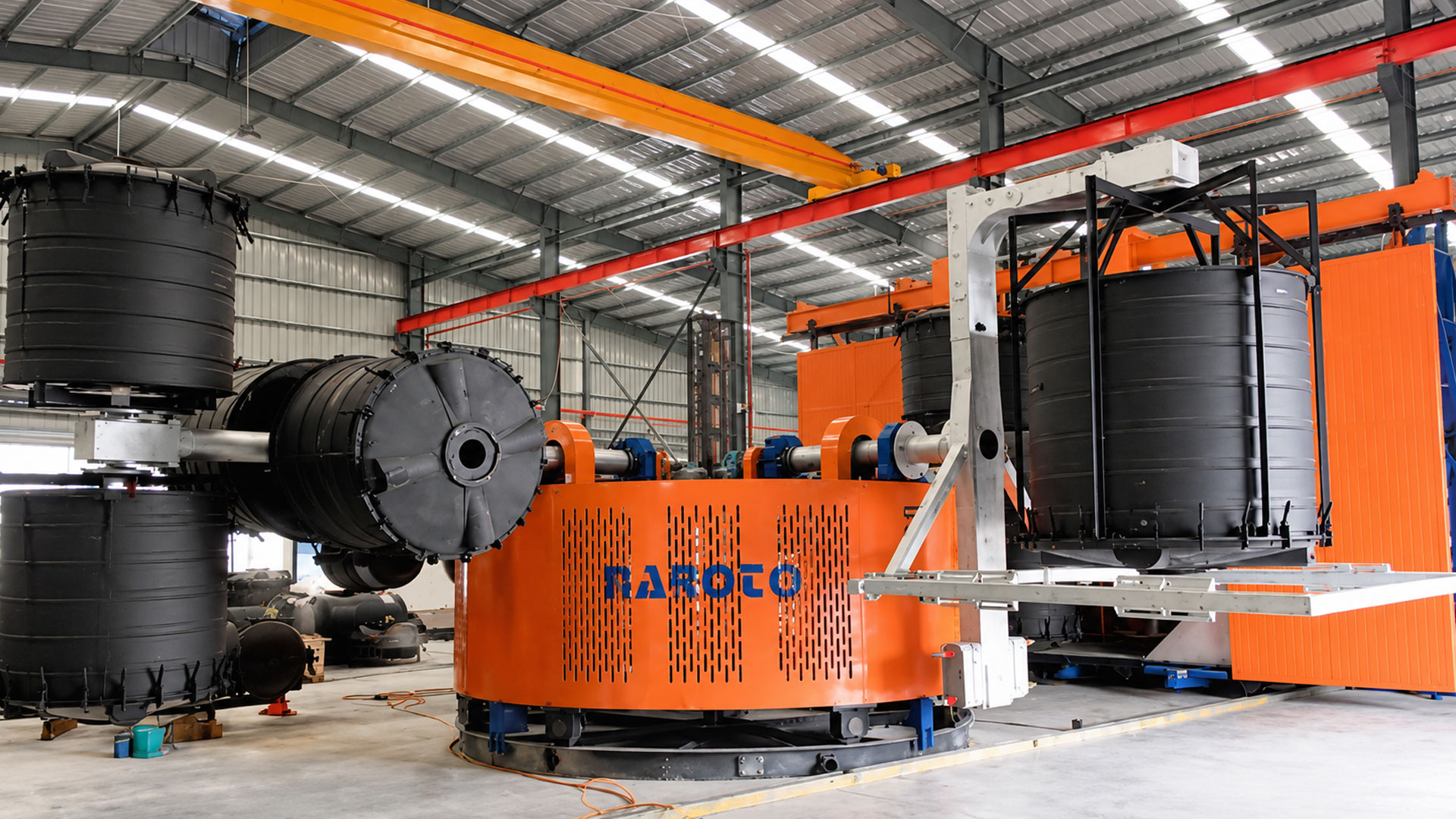
For buyers comparing established rotomoulding machinery manufacturers in India, Naroto offers machinery, moulds and ancillary equipment as part of its rotomoulding portfolio and positions itself as a one-stop provider for turnkey projects. Its manufacturing facility is stated by the company to span approximately 2,00,000 sq. ft.
Its equipment portfolio includes solutions for different production requirements, including independent-arm machinery designed to process varied products with different processing times, alongside ancillary systems such as pulverisers, extruders, scrap grinders, cutters and mixers.
This broader capability matters because increasingly, manufacturers are not looking for a machine alone. They are looking for a production system that can grow with the business.
Final Thoughts
Finding the best rotomoulding machine manufacturer in India is ultimately less about finding the biggest name and more about finding the right engineering partner.
Compare technology.
Compare cycle efficiency.
Compare manufacturing capability.
Compare service.
Compare tooling.
Compare what happens five years after installation—not simply what appears impressive during the sales presentation.
A rotomoulding machine may be purchased once.
Its performance becomes part of your factory every working day.
Choose accordingly.
